02 JUL 2026

Pilates for a Resilient Rotator Cuff and a Mobile Mid-Back
If you’ve read our Pottsville Physio blog articles on rotator cuff related shoulder pain (RCRSP) and the thoracic spine, you’ll have picked up two themes: the shoulder needs strength and capacity, and it needs a mobile mid-back underneath it to move well. Pilates happens to be brilliant at building both — which is exactly why it’s one of our favourite tools for shoulders at Pottsville & Cabarita Physio.
Let’s be clear up front: Pilates isn’t a magic cure, and it works best as part of a well-structured plan rather than instead of one. But as a way to build a stronger, more controlled, better-moving shoulder-and-spine system, it’s hard to beat.
Why Pilates suits shoulders so well
Rehabbing a cranky shoulder isn’t just about brute strength. It’s about control — teaching the shoulder blade and rotator cuff to work together smoothly through range — and about movement quality through the whole chain, from mid-back to shoulder blade to arm. Pilates is built around exactly these principles:
Scapular control — so much of Pilates involves setting and moving the shoulder blades with intention, which is gold for the rotator cuff.
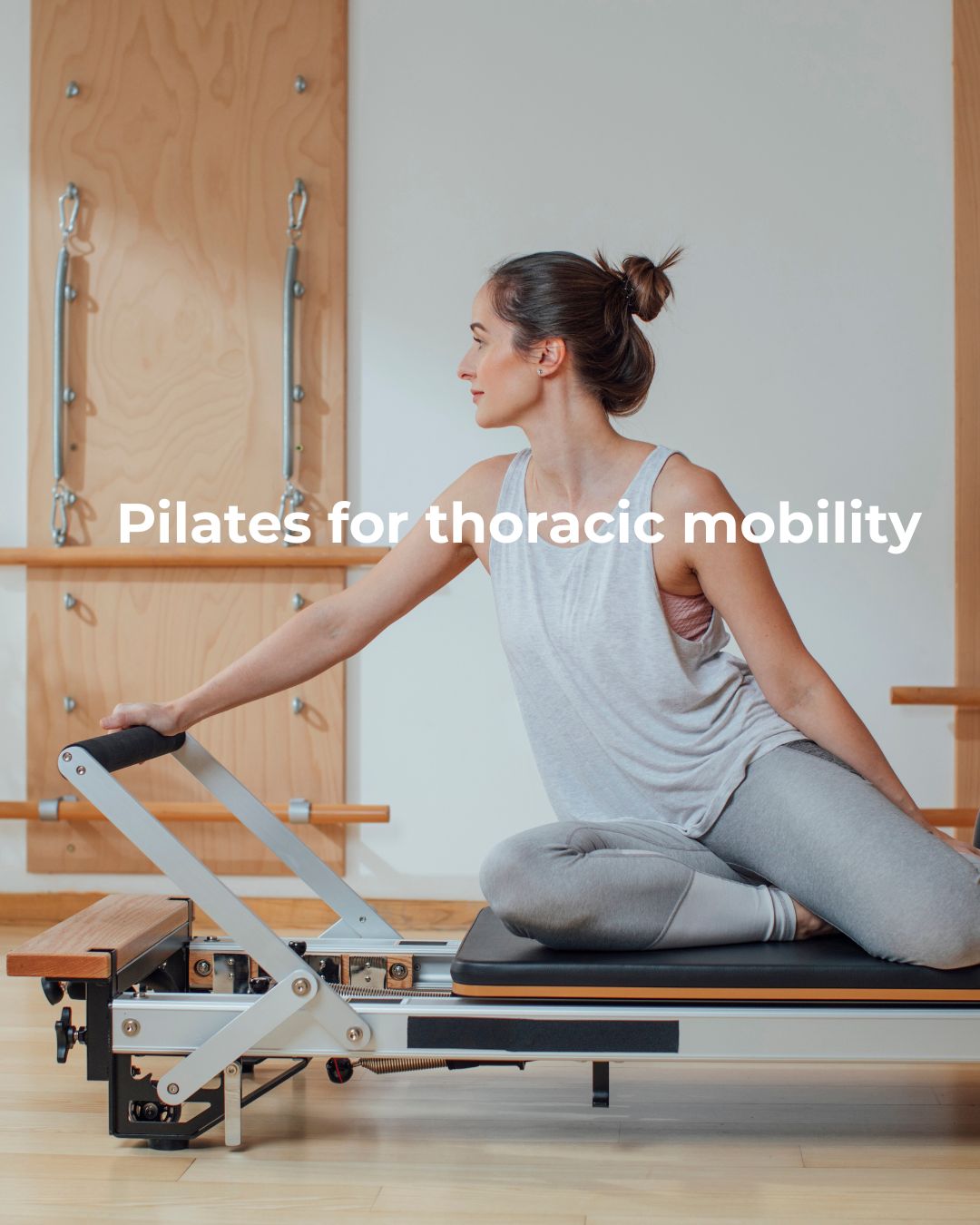
Thoracic mobility — rotation, extension and side-bending of the mid-back are woven throughout, directly targeting the stiffness we know is linked to shoulder pain.
Progressive, controlled load — springs, bands and bodyweight let us load the shoulder gradually, which is precisely what tendon and cuff rehab needs.
Mind-body awareness — you learn where your shoulder is in space and how to move it without guarding or bracing.
What a shoulder-friendly Pilates session looks like
In our clinical Pilates and studio sessions, a shoulder-and-thoracic focus might include:
Thoracic rotations and “open book” movements to free up the mid-back.
Scapular setting and gliding drills — retraction, protraction, elevation and depression with control.
Supported rotator cuff work using light springs or bands for external and internal rotation.
Overhead loading, progressed carefully — reaching and pressing patterns built up as your capacity grows.
Full-chain integration — connecting breath, mid-back movement and shoulder control in flowing sequences.
The mobility-and-control combination
The reason Pilates lands so well for shoulders is that it doesn’t force a trade-off between moving well and being strong. A lot of people chase one at the expense of the other — they stretch endlessly but stay weak, or they load heavily but move stiffly. Pilates trains them together: mobile mid-back, controlled shoulder blade, progressively stronger cuff.
For overhead-heavy locals — the Cabarita surfers, the ocean swimmers, the tradies reaching overhead all day — this combination is exactly what keeps a shoulder resilient under repeated load.
Is Pilates right for your shoulder?
Pilates is genuinely adaptable — it can be scaled from very gentle, early-stage rehab all the way to challenging, high-load training. If your shoulder is currently painful, the smartest first step is an assessment so we understand what’s going on and can tailor the exercises to your shoulder rather than a generic routine. From there, Pilates can slot neatly into your rehab and, later, into keeping the problem from coming back.
Because our staff are both a physiotherapists and a Pilates instructors, we’re able to bridge the two worlds — clinical assessment and reasoning on one side, skilled Pilates coaching on the other — in a way that’s tailored, safe and genuinely effective.
Curious whether Pilates could help your shoulder? Come in for an assessment and we’ll map out the right starting point for you. Book a session with Pottsville & Cabarita Physio.
Written by Melissa Macdonald, Physiotherapist & Pilates Instructor, Pottsville & Cabarita Physio.
This article is general information and not a substitute for individual assessment. Please see a physiotherapist before starting a new exercise programme if you have shoulder pain.